Biography: Adelaide Branch, Hidden Woman


News banner, December 27, 1913

By Tom Rue

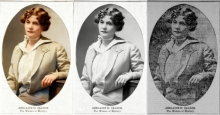
This is a story that has pulled at me for years — of Adelaide Mary Branch (1873–1948), a woman whose life unfolded at the edges of visibility, often at the mercy of narratives not her own. Born into a locally prominent family in Hartwick, Otsego County, NY, she turned away from expectations placed upon her -- of marriage, of inheritance, of respectable womanhood -- and sought to define herself on her own terms. Yet the price of this autonomy was steep. She died in 1948 under her adopted pseudonym of Mary Douglas, and was buried in an unmarked grave.

Watch this space for news on publication or email asking to be placed on our mailing list.

What's In A Name?

Adelaide Branch’s adoption in 1914 of the pseudonym Mary A. Douglas was a deliberate act of reinvention following the public scandal surrounding her relationship with Melvin Couch and her subsequent voluntary confinement in his law office. The name change coincided with her physical relocation—first to Bermuda with the Sinclairs, then to Croton-on-Hudson, New York, then Morningside Heights in the city, and finally Washington, DC. She lived under this new identity for the rest of her life. Unlike the sensationalized "hidden woman" narrative that defined her in the press, "Mary A. Douglas" allowed her to dissociate from her past, secure employment and social standing, and engage in intellectual and political dialogue.

Dorothy Dix's interview (1913)

One journalist of the day who was granted an interview by Adelaide Branch before she left Monticello was Dorothy Dix (nee Elizabeth Meriwether Gilmer), the first and most famous newspaper dispenser of advice to the lovelorn. Dix said a fair telling of the story of Adelaide Branch required a woman’s perspective. With an estimated audience of 60 million readers, Dorothy Dix was a columnist employed by William Randolph Hearst. At the time of her death, her obituary said she was the highest-paid and most widely read female journalist.

"A Life in the Margins," Tom Rue (2025)

In the turbulent shadows of America's Gilded Age and Progressive Era, one woman's life wove through the circles of literary giants, radical reformers, and hidden revolutionaries. The Hidden Woman brings to light the extraordinary yet overlooked journey of Adelaide M. Branch -- a "pretty book agent" turned resilient survivor, who crossed paths with Upton Sinclair, Dr. Marie Equi, Dr. James and Agnes Warbasse, Emma Goldman, and other luminaries of social change.

"Who was Adelaide Branch?," Tom Rue (2025)

Adelaide Mary Branch, later known as Mary Douglas, was born in 1873 into a respected Hartwick family, but refused the genteel life expected of her. After early loss and estrangement, she chose unconventional paths throughout her life -- guided by love and moral conviction rather than social conventions or others' approval. As a child, Addie was a devoted and loving daughter whose parents died before she was fully grown, one by suicide and one of cancer. As an adult, she maintained her caretaker, teacher, and healer core values. An Ohio newspaper quoted her, “As soon as we strip off this little fleshy veil, we are all love for every human soul.” ("Miss Branch Tells Her Story - Heart Mate of Monticello Lawyer Declares She Has No Regrets", Columbus Daily Statesman, December 27, 1913.) A forthcoming biography reconstructs a well-documented portrait of a woman of independent spirit and deep emotion, who defied the conventions of her era, abandoning a privileged lineage in Hartwick, Otsego County, New York, to live

"The Heart Wife," Upton Sinclair (1919)

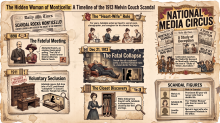
For an overview of a highly publicized scandal that happened in Monticello, New York, shortly before Christmas in 1913, interested readers can link here to Chapter XXII of The Brass Check by Upton Sinclair (1919), while awaiting publication of "The Hidden Woman" biography of Adelaide M. Branch (later known as Mary Douglas) during 2026. 

"No Primrose Path," Sam H. Clark (1914)

Jim Jam Jems was an independent, muckraking magazine published from Bismarck, North Dakota, beginning in 1912 and continuing into the late 1920s. It presented itself as a blunt, truth-telling journal with a flair for sensationalism. Each issue was a small booklet, typically around sixty pages, and sold for twenty-five cents. Its content mixed exposés, moral and social commentary, satire, political criticism, and vivid human-interest narratives. The magazine frequently tackled topics considered taboo at the time: prostitution, “white slavery,” corruption, medical abuses, wartime politics, and perceived moral decline. Its voice was deliberately provocative, aiming to jolt the reader rather than maintain journalistic decorum. The February 1914 issue (when the actual events were still fresh in the news) presented a sordid and moralistic rendition of the story of Adelaide and Melvin in the village of Monticello, Sullivan County, New York.
Subscribe to Adelaide Branch

RSS Feed