By Tom Rue
After a pause, in May of 2025, I returned to a project that I had suspended in 2008 after its intended publisher at that time canceled all unsigned book agreements due to an economic downturn that we now call the Great Recession. Stopping my research, discouraged over the publishing contract being canceled, I focused instead on a different locally focused book that was published in 2010, and put this one aside.
But this story has pulled at me for years — the biography of Adelaide Mary Branch (1873–1948), a woman whose life unfolded at the margins of visibility and belonging. What happened in May to call me back was the accidental discovery of a death certificate in the name of her death certificate -- under a different name -- dated 1948. There was no question it was her. When the certificate seemingly dropped from the sky, I explained to my wife Jill the document and how it fit into, and in a sense completed, the biography I began writing in 2008. "I'm going to finish that book!", I told her.
At the time the story of the hidden woman of Monticello first caught my attention, I was serving as municipal historian for the Village of Monticello as well as historian for Monticello Lodge #532, F&AM, the former owners of the building where portions of this 2013 drama took place. In 2008, these roles allowed me access to spaces and records, both locally and elsewhere in the country. I no longer wear either of those hats, but this story still calls out to me to finish and share.
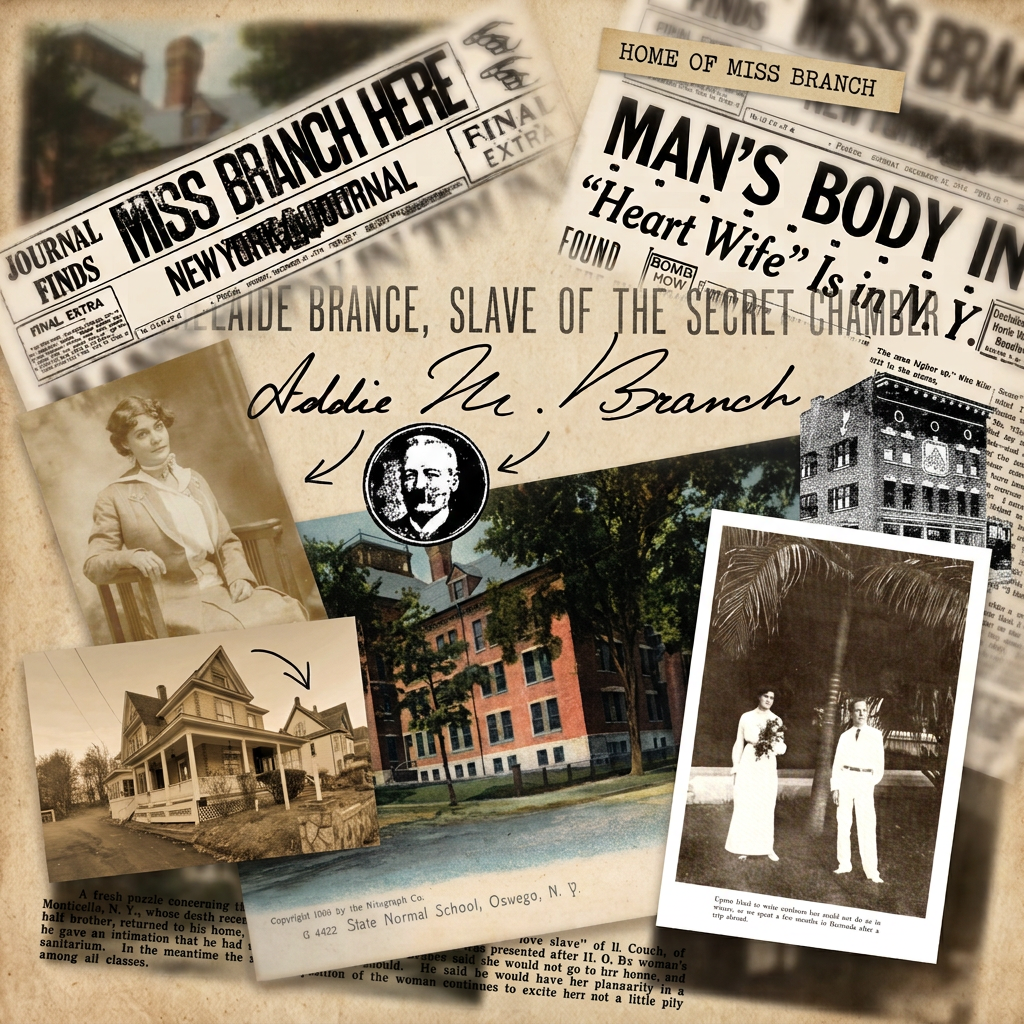
Adelaide was born into a locally prominent Otsego County family, with a future that seemed pre-written: marry well, uphold the family’s standing, and never step beyond the bounds of “respectable womanhood.” Trained at Oneonta Normal School, she taught briefly but then refused all of it. Turning away from inheritance and expectation, in 1898, she struck out on her own, traveling from town to town in upstate New York, selling advance subscriptions to a biography of retired Rear Admiral George Dewey of Spanish-American War fame. The price of Adelaide's autonomy was steep: estrangement from her family, public scandal, and a lifetime of living between worlds — never fully accepted in any of them.
A letter dated July 27, 1898, from Adelbert M. Dewey to Louis Marinus Dewey summarized a successful sales approach the publisher suggested to young book agents, advice which Addie took when she arrived in the small Catskill Mountain village of Monticello:
"A woman canvasser here at the hotel says she can walk through the offices of professional people in any large city and sell twenty of those books per day. She has sold books for several years and only calls on such people in each city."
In the same letter, A.M. Dewey told his brother that in August he would recruit book agents, "...going to Utica, N.Y., and taking in Watertown, Oswego, Ogdensburg, and Saratoga Springs, in the order named. I like the assignment."
When Dewey spoke in Oswego, where Addie Branch had been attending college, her life took a turn.
Her new work as a traveling book agent ultimately took her to professional offices in space rented from the Monticello Masonic Lodge, which owned the building. This office, on the north side of the hall on the second floor, was where Addie met and became enamored of an elderly former county prosecutor named Melvin Couch. He not only ordered a book, but he took her out to a meeting of lawyers and urged all his friends to buy a book to help the young lady out. This was 1898 or 1899. Their friendship grew. In 1903, Addie received her licensure to teach in New York State public schools, but she focused her attention elsewhere as her affinity for Couch grew deeper and Couch developed medical issues.
Couch walked with a limp since a youthful sports injury, the bone in his leg now wasted by tuberculosis, but was, by all accounts, a pleasant, kind, and respectful to everyone who knew him. After meeting in 1898, Mel Couch became close friends with the pretty book agent, often visiting for hours of conversation at his office while she kept her residence at a rooming-house in Goshen. He is reported to have suffered tuberculosis in the bone of his leg. He ultimately died of massive heart failure, in Addie Branch's arms.
At times, Couch's wife Jannet (with whom he lived on East Broadway) would go for extended visits to visit her family in Indiana, though Jannet and her daughter were in town the night Couch died. Mr. and Mrs. Couch were not estranged, but their relationship was stressed during this period. In July 1910, their grown son died suddenly of heat prostration on the streets of New York City during a heat wave. Their shared loss of Steven they experienced does not appear to have brought them closer. [2]
Addie often stayed overnight in Melvin's office at the Masonic building, doing his typing and filing. She maintained a room with the Ostrums in Goshen, but spent as much time in Monticello visiting with Melvin as she could.
They kept this secret from the very first because the space was a commercial office building, but primarily because Melvin's wife knew nothing of the younger woman's frequent presence in his office. When the massive blaze of August 9, 1909, consumed much of Monticello, Addie said she was away in Goshen. She told a reporter that her clothes and belongings were all lost in that fire. In 1910 (the Freemasons quickly rebuilt the office building and their meeting room on the third floor Masonic Temple), Addie moved into Couch's law office full-time, secreting herself in a closet where Couch kept her as comfortable as she wished, immersed in a deep belief that her devotion to this man gave her life meaning. After his death, Addie consistently spoke of Couch with profound respect.
This book will seek to understand why Addie might have made the life choices that she did. Readers may question whether her choice to disregard social conventions of the time and follow her heart was shaped by trauma, societal constraints, or love, but Miss Branch had a strong intellect and a free will. Added to this, had Couch wanted a divorce, New York's laws in those days resulted in economic and emotional harm to both spouses. So, since he couldn't easily get divorced, he and Addie agreed that she would remain hidden.
For three years, until December 23, 1913, she lived in near-total isolation in a closet-sized room off of Couch's law office, tending to his failing health. She called herself his “heart wife”, a term she used to distinguish her emotional bond from his lawful marriage — a challenge to the norms of her time. When Couch died, he was publicly mourned; Adelaide was jailed. Her story was luridly emblazoned on the front pages of dozens of newspapers across the United States for weeks.
While in the Sullivan County Jail, it was widely reported that she received offers of aid from around the world, ranging in number from "scores" to "hundreds". Some reportedly offered to marry her. One letter was from the social activists Upton Sinclair and Mary Craig Sinclair, who ultimately referred her to a physician friend, Dr. James P. Warbasse, and his wife Agnes Warbasse. Addie chose the Sinclairs' letter out of a pile of similar offers, perhaps in part because of Upton Sinclair's reputation as a muckraking journalist and for his opposition to the mass placement of people who differed from patriarchal gender norms in state asylums.
Dr. Warbasse helped to facilitate her admission to a short-term stay in a sanatorium on Long Island, preventing hospitalization in a state asylum at least for a time. Later the same year, she followed the Sinclairs to their winter home in the Bahamas, where they and their fellow travelers tried to support Addie's decision to "work out her own salvation" without being incarcerated.
Though 40 years old when she left Monticello, she was referred to the Florence Crittenden Mission for wayward girls in Washington DC. Immediately before her death, it is known that she lived in the District of Columbia before returning to New York to die. Details on that period of her life are still emerging.
Her later years were lived as “Mary Douglas” (the name on her death certificate), a name she first began using shortly after she fled Monticello in early 1914 to escape William Randolph Hearst's newspaperman's extreme attempts to photograph and publish her story. She died of unspecified "natural causes" in 1948 at St. Luke’s Hospital in Manhattan and is buried in an unmarked grave in Valhalla, Westchester County, New York.
From a feminist perspective, Adelaide’s life is not merely a curiosity or local footnote. It’s a lens on the politics of othering — the way women who step outside accepted scripts of love, labor, and identity are often punished, silenced, or erased. As john a. powell has written, othering denies individuals “full inclusion in the circle of human concern.” Adelaide’s story shows that exile can come not just from strangers, but from family, lovers, and institutions.
“As soon as we strip off this little fleshy veil, we are all love for every human soul,” Adelaide told a reporter from Columbus, Ohio. [3]
Her story is not simply of love and devotion, nor simply of sacrifice. It is a story of how a woman, in seeking autonomy, can be exiled from every circle of belonging — by family, by society, and by the man she served. It is also the story of how, despite this, she held onto a vision of love that to her was expansive enough to transcend the brick walls around her.
Resuming this project means sifting through government and medical records, personal correspondence, press accounts, and oral history to reclaim her life from obscurity. The Hidden Woman will not romanticize her choices, but it will insist on seeing them — and on recognizing that the cost she bore was as much about the society she lived in as it was about her own decisions.
I’ll be sharing updates here as the manuscript and publication plans develop, both to document the research process and to invite reflection on the larger questions Adelaide’s life raises:
- What happens to women who choose love without legality?
- What does service look like when it’s offered without recognition?
- How do we honor lives that refused the protection of convention?
This is more than a biography. It is a look at how women who step outside society’s narrow circle of belonging have been punished, silenced, and forgotten — and how telling their stories becomes an act of restoration.
Bringing Adelaide’s back story into the light is, for me, a small act of historical justice. She may have been hidden in her lifetime — but she will not be forgotten. The social reformer and author Upton Sinclair, who aided her, commented in his "Story of Adelaide Branch": "If that be not the raw material of human drama, then I don't know it when I see it!" [3]
Watch this space for further details as the book progresses. Email the author.
References:
[1] Upton Sinclair, “The Story of Adelaide Branch” in The Brass Check: A Study of American Journalism, 1919.
[2] "Dies on the Street in New York. Steven B. Couch, son of M.H. Couch, Stricken With the Heat on Wednesday", The Republican Watchman (NY), July 29, 1910, p. 1.
[3] "Miss Branch Tells Her Story - Heart Mate of Monticello Lawyer Declares She Has No Regrets", Columbus Daily Statesman (OH), December 27, 1913, p. 1,
Introduction to the current draft of The Hidden Woman (246-page mss. as of 10/14/2025.)
![]()
Related reading:
- Schwabauer, Daniel. “The Heart Wife”, in Byline: Homeschool Writing Curriculum, February 9, 2018. Olathe, KS: Clear Water Press.
- John Conway, Times Herald-Record, "'Hidden Woman' Becomes A National Scandal, December 16, 2010, Middletown, New York
- Sinclair, Upton, "The Heart Wife", chapt. 23 in The Brass Check: A Study of American Journalism. Pasadena, CA: The Author, 1919 (pp. 130-141).
- Marine-Street, Natalie, “Agents Wanted”: Sales, Gender, and the Making of Consumer Markets in America, 1830–1930 (PhD dissertation, Stanford University, March 2016).
- Halstead, Murat, The Life and Achievements of Admiral Dewey: From Montpelier to Manila. Chicago: Our Possessions Publishing Co., 1899.
Titles with themes comparable to The Hidden Woman:
- Lobdell, Bambi L. A Strange Sort of Being: The Transgender Life of Lucy Ann / Joseph Israel Lobdell, 1829-1912. Jefferson, N.C.: McFarland & Co., 2012.
- Moore, Kate. The Woman They Could Not Silence: One Woman, Her Incredible Fight for Freedom, and the Men Who Tried to Make Her Disappear. Naperville, IL: Sourcebooks, 2021.
![]()