tomrue
6 September 2026
The Adelaide Branch Biography Project
tomrue
8 August 2025
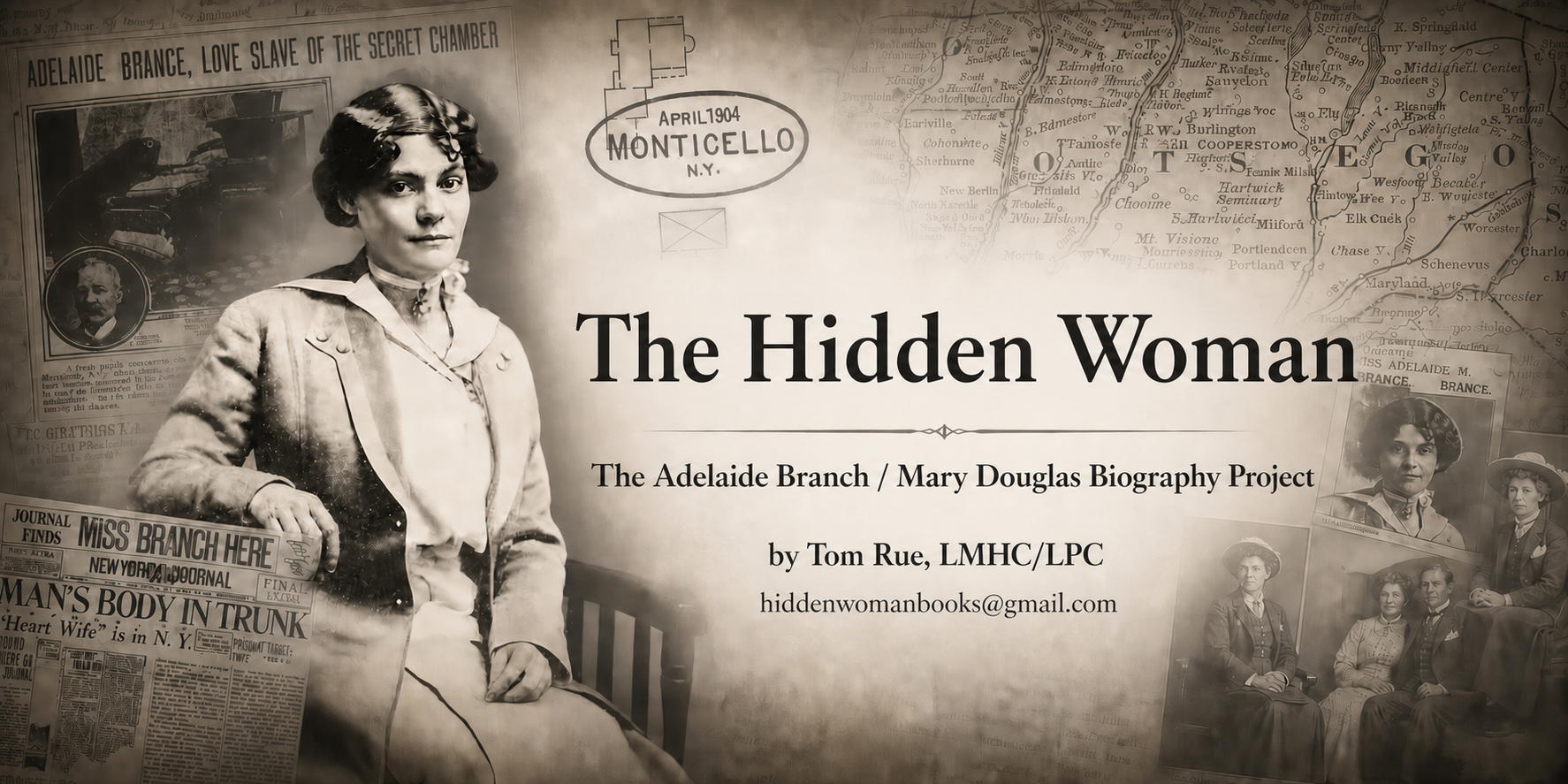
Click here for more information on a forthcoming biography by Tom Rue of the life of Progressive Era public school teacher and feminist writer, Adelaide M. Branch (1873-1948); how and why she changed her name in 1914 to Mary A. Douglas, a free-thinking woman whose life was changed by traumas. She didn't just survive, but flourished as an independent feminist author based in New York City and later in Washington, DC, with the mentorship and aid of Upton Sinclair and others who were prominent in the progressive movement of the time, as well as of the James N. Jarvie Commonweal Service later in her life.

Tags
From Progressive Manifesto to Pulp Romance: The Literary Evolution of Mary A. Douglas (1917–1938)
tomrue
12 September 2026
Following her 1913 rescue from Melvin H. Couch's secret law office partition in Monticello, New York, Adelaide Mary Branch (1873–1948) adopted the reclaimed identity Mary A. Douglas. Over the next three decades, she navigated two distinct spheres of American publishing: high-minded Progressive Era social critique and commercial pulp fiction.
This comparative analysis contrasts her landmark 1917 feminist essay, "What the World Owes to Spinsters" (published in Mitchell Kennerley's The Forum), with her 1930 commercial romance story, "A Silent Altar" (published in Frank A. Munsey's All-Story). Together, these works illustrate how an unmarried, self-supporting woman adapted her literary talents to achieve economic autonomy during the Great Depression.
Tags
The Monticello Incident, October 1913
tomrue
12 September 2026
Summary of the Case: In December 1913, a sensational scandal broke in Monticello, Sullivan County, New York, following the sudden death of former county prosecutor and lawyer Melvin H. Couch. Upon Couch's death from a ruptured aorta in his law office, authorities discovered that Adelaide Mary Branch (1873–1948), an educated former teacher and traveling book agent, had been living secretly for three years (1910–1913) in a small partitioned room off his office. Branch referred to herself as his "heart wife," tending to his declining health in near-total isolation.
- Read more about The Monticello Incident, October 1913
- Log in to post comments
FROM PARTITION TO MANIFESTO: The Rebirth of Adelaide Branch as Mary A. Douglas (1914–1948)
tomrue
10 September 2026
YELLOW JOURNALISM vs. THE SOBER RECORD: Comparative Media Framing of Adelaide Branch in the 1913 Monticello Scandal
tomrue
10 September 2026
The Brass Check in the Digital Age: Upton Sinclair’s Media Critique and the Crisis of Modern Journalism
tomrue
10 September 2026
The Politics of Secrecy: Mrs. Jacob Maybee's Suffragist Defiance versus Mrs. Janette Couch's Victorian Acquiescence in the 1913 Monticello Scandal
tomrue
10 September 2026
The Rival and the Advocate: A Biographical Profile of Judge George H. Smith
tomrue
10 September 2026
THE TRIUMVIRATE OF PROSECUTORS: Parallel Careers, Ideological Clashes, and Shared Hallways of Sullivan County’s District Attorneys (1886–1914)
tomrue
10 September 2026